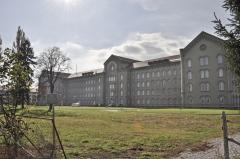
THE CADET SCHOOL
Location: Engelsova ulica 15
Architect: August Sicard von Sicardsburg, Eduard van der Nüll
Time of construction: 1853-1856
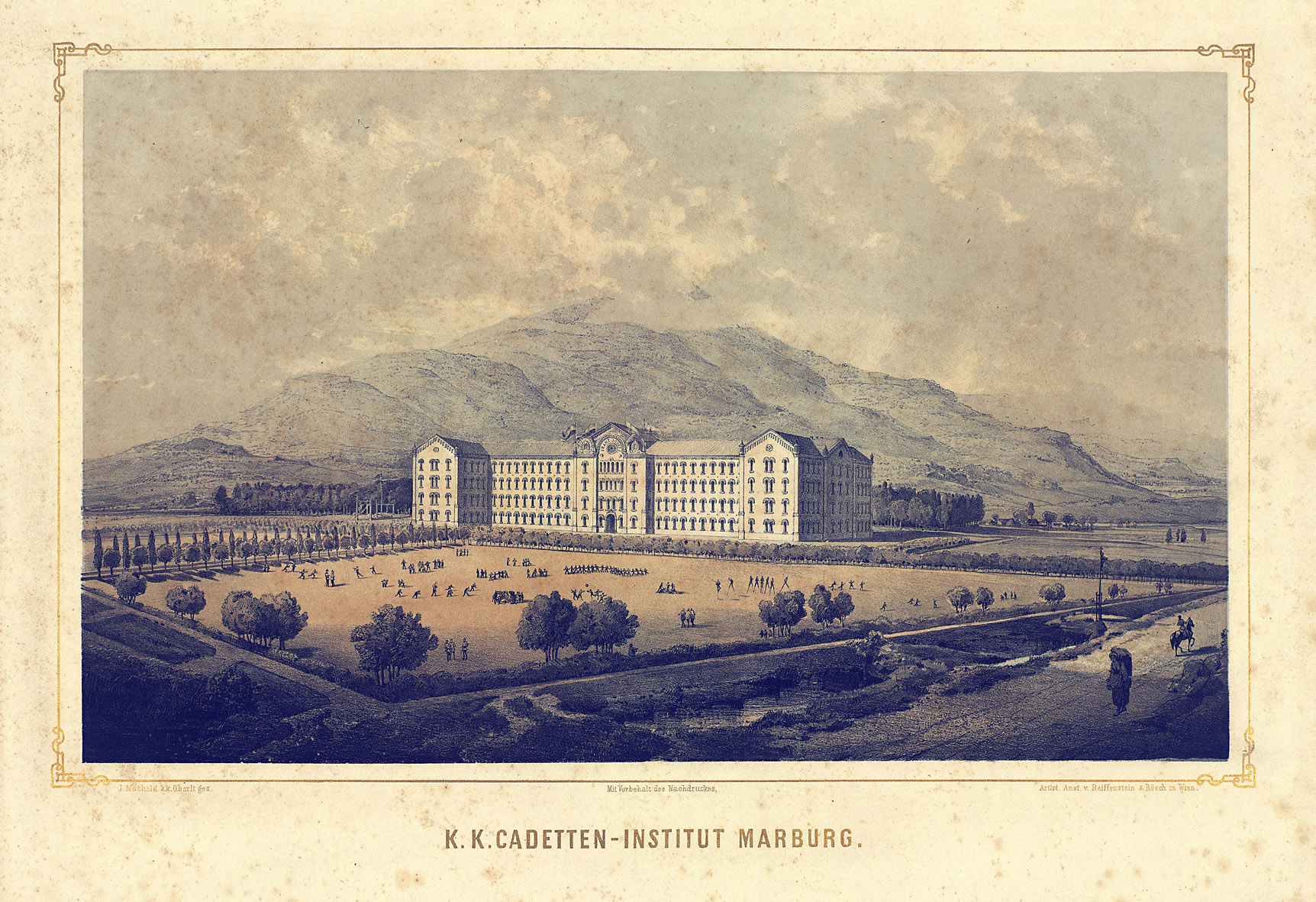
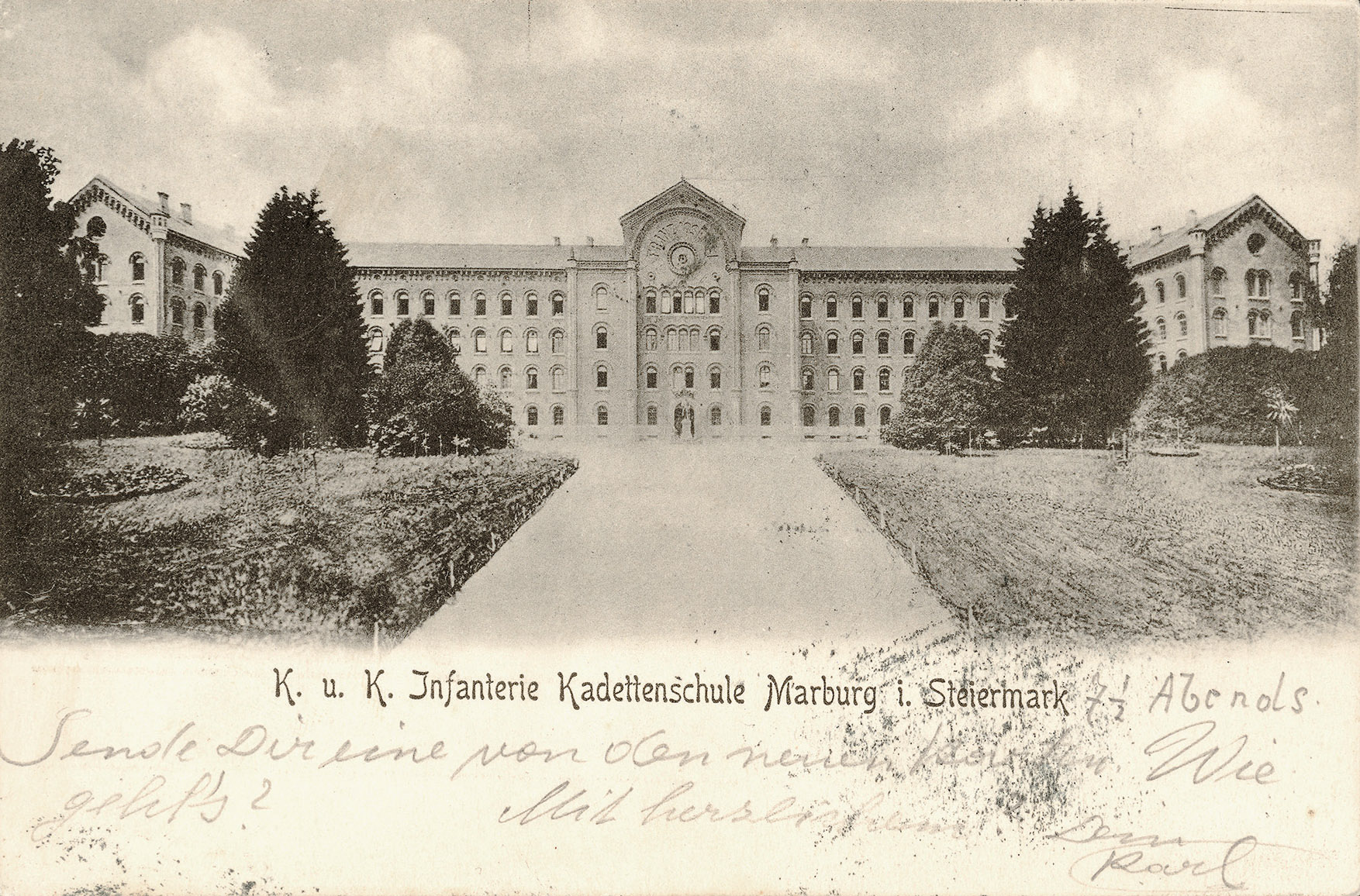
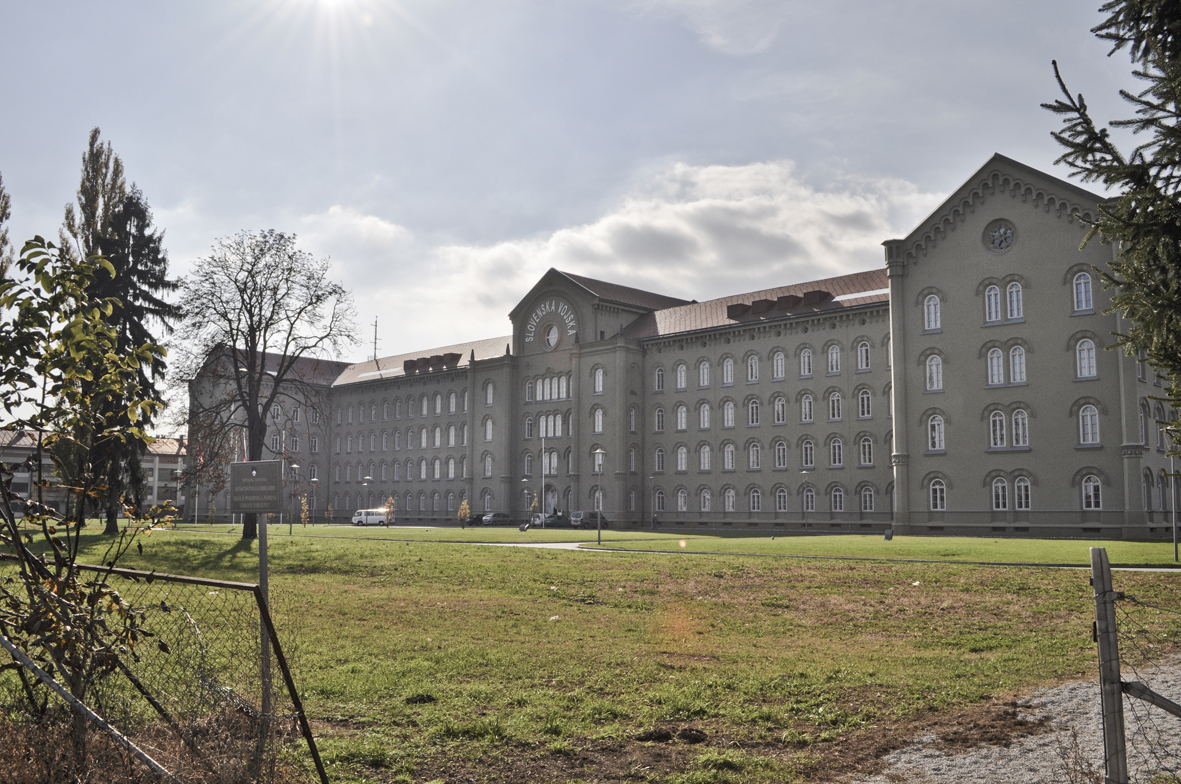
After the revolutionary year of 1848, several cadet institutes were established in the Austro-Hungarian Monarchy (Maribor, Hainburg, Eisenstadt, Rijeka, Liebenau near Graz), where future officers gained their education. In Lower Styria, they originally planned a school in Novo Celje Mansion near Petrovče, but the project fell through because the owner opposed. For this reason, they decided to build a new building on the outskirts of Maribor, on the right riverbank of the Drava River, which was mostly undeveloped. The plans for the monumental building were made by Viennese architects August Sic(c)ard von Sic(c)ardsburg (1813-1868) and Eduard van der Nüll (1812-1868), while building master Carl Ohmeyer (1818-1856) from Graz was the head of construction. The company of Johann Stichl, a stonemason from Ptuj and Maribor, provided the stonemasonry. The building was used as a cadet institute until 1870, when a military post was established there. The infantry cadet school was re-established in 1894 and was active until 1919. After that it operated as a military post again, which lasted until Slovenia gained independence. From then on, the building was left empty and decaying. Between 2007 and 2008, it was thoroughly renovated for the needs of the Officer Cadet School, The Doctrine, Development, Education and Training Command, and The Military Museum of Slovenian Armed Forces. Even though the renovation was highly successful, a lack of knowledge about 19th century architecture resulted in the façade being an inadequate grey-green, which diminishes the building's monumental appearance.
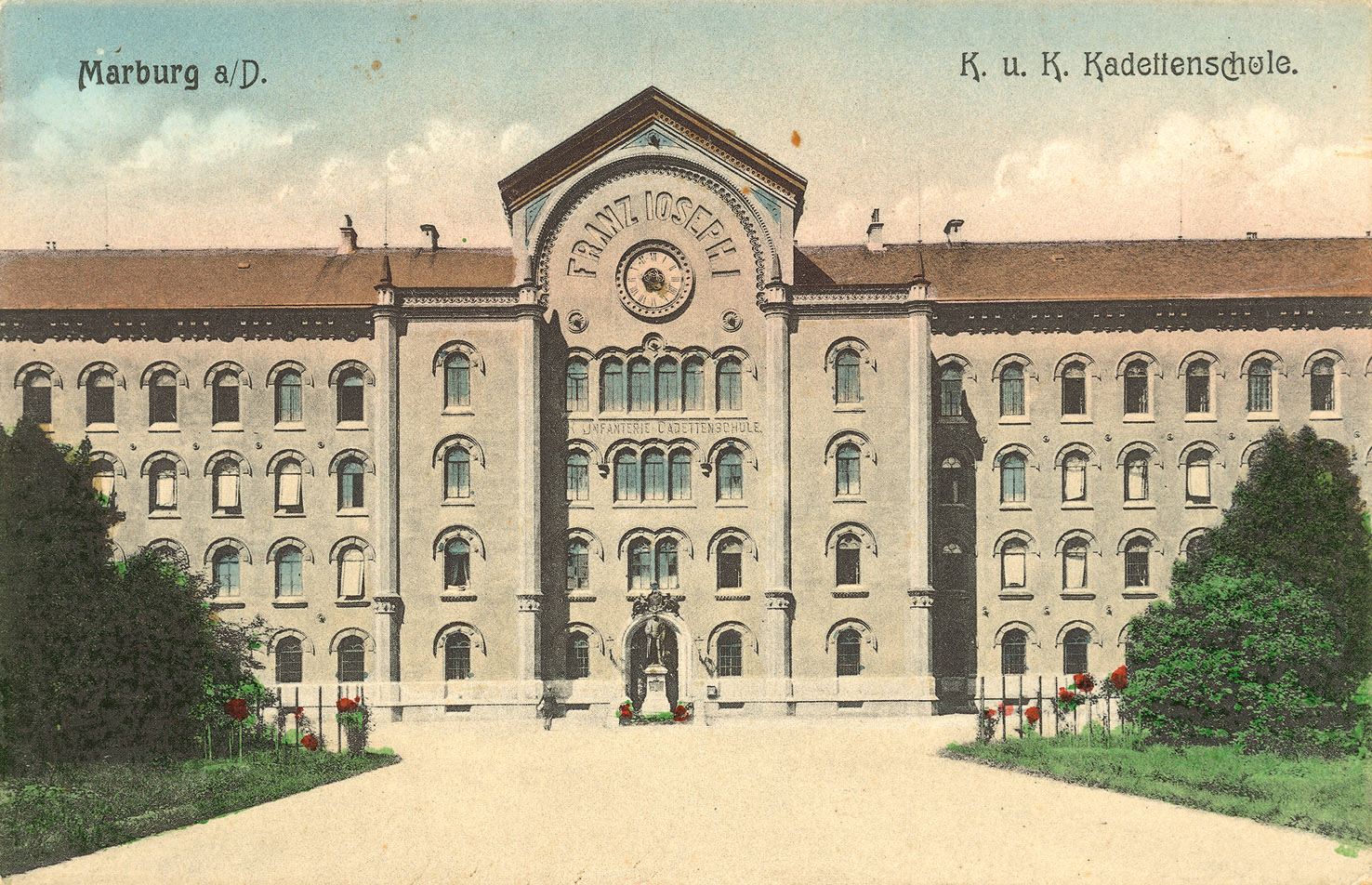
The ground plan of the four-storey building with a partial basement and a mansard is in the shape of the letter H. The longer central wing has a twenty-nine-bay façade, while the shorter wings have eleven four-bay façades. The central projection of the longitudinal wing is slightly elevated. The exterior is divided by semi-circular windows surmounted by semi-circular arches. The cornice is decorated with arcaded cornice, which is characteristic for the architecture of the middle of the 19th century. The upper part of the façade is decorated with turrets and other stonemason and terracotta decorations, however, the latter are not noticeable enough owing to the inadequate colour of the façade. The vaulted pillared entrance hall, a two-flight staircase with a landing, and the central hall in the second storey, where a chapel originally stood, are preserved in the interior.
As with other contemporary military buildings in the Austrian Empire, the architectural characteristics of the Maribor Cadet School are modelled after the most important military construction from the middle of the 19th century, the Vienna Arsenal. The Arsenal, which was built between 1849 and 1856, is comprised of several buildings that were planned by leading Austrian architects of the Romantic (or Early) Historicism, including August Sicard von Sicardsburg and Eduard van der Nüll. Among the cadet institutes that were built in the middle of the 19th century, the Maribor Cadet School resembles most the Cadet School in Eisenstadt in Burgenland (today Martinkaserne, 1853-1858); however, it is also very similar to the Cadet School in Liebenau near Graz (today a secondary school, Carl Ohmeyer, 1852-1854). The Maribor Cadet School is one of the rare examples of Romantic Historicism in Slovenia, as well as one of the country's largest buildings from the mid-19th century. It is adorned with Neo-Romanesque decorations. The school's monumentality and its placement had an impact on the urban image of Maribor's right riverbank. The building itself was surrounded by green areas (an avenue and park), while in 1899, a full-figure bronze monument of the emperor was erected in front of the façade. The monument was made by Viennese sculptor Edmund Hofmann von Aspernburg (1847-1930) in order to commemorate the fiftieth anniversary of the rule of Franz Joseph I. Unfortunately, after the dissolution of the Austro-Hungarian Monarchy, the statue was destroyed, however, the pedestal was preserved. The restored pedestal now awaits its new function.
Franci Lazarini
(23 September 2014)