The Monument to Emperor Franz Joseph I
Cadet School (until 1918)
Edmund Hofmann von Aspernburg
1899
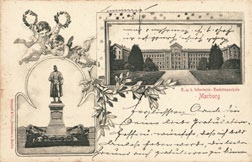
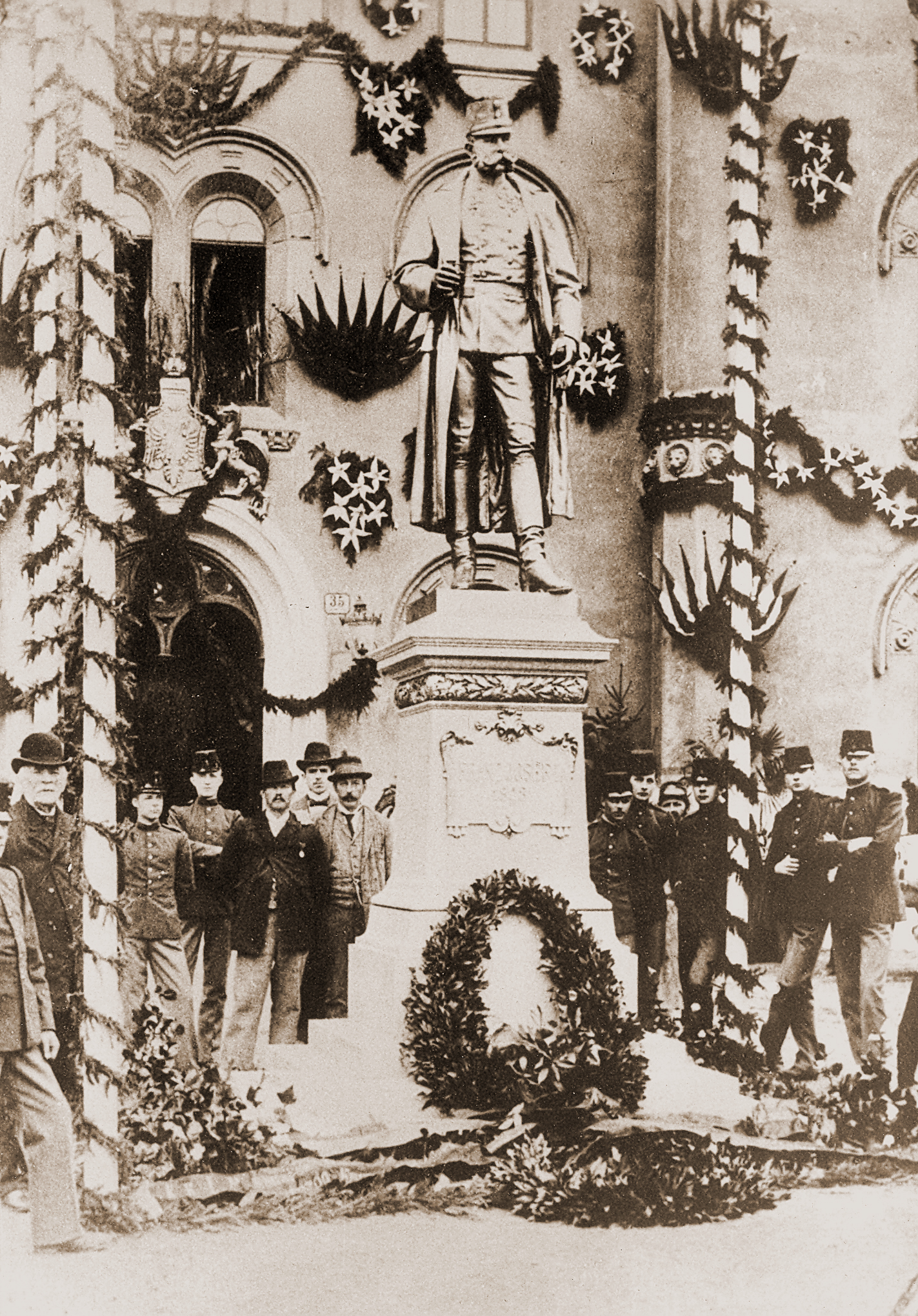
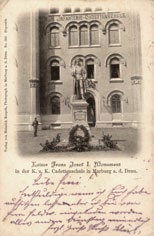
According to a description in Marburger Zeitung, the emperor's statue stood on a 2,5 metres high granite pedestal that was decorated with a laurel wreath and a bronze plaque with the inscription "Franz Josef I. 1898". The monument was made by sculptor Edmund Hofmann von Aspernburg (1847-1930) to commemorate the emperor's fiftieth birthday. Even though the unveiling of the monument was postponed for a year because the emperor's family was in mourning (on 10 September 1898 Empress Elizabeth was murdered), they did not change the year inscribed on the plaque. The oversized monument (2,35 m high) was cast of the best bronze cannon alloy that was made in the Hans Frömml foundry in Vienna. The Emperor was portrayed in a field marshal uniform with a coat and a hat, just as the soldiers saw him during manoeuvres. His coat was unbuttoned; he held binoculars in his right hand, while with his left, he was leaning slightly on the sabre. On the pedestal, the artist captured him in the most vivacious and natural pose typical of when one is listening and observing.
Even though the sculptor did not surpass the formal expression of his teachers when making the statue, Maribor's monument was one of the earliest portrayals of Emperor Franz Joseph I as a soldier. This is also the reason why it was so well received in public. Even the imperial court and the generals in Vienna praised it. An older portrayal of the emperor was made in 1897 for Waidhofen in Lower Austria, where he was presented in a marshal uniform. The motif of the soldier did not grow into an almost industrial production until after 1900. The first freestanding statue of Emperor Franz Joseph I was made in 1904 by Johannes Benk (1844-1914), who also made a monument of the emperor in 1908. In visual art the latter became the model for the personification of power, trust and confidence, which were also the emperor's qualities. Furthermore, it became a prototype for all further freestanding representations of the Emperor. The statue was first placed in the town park in Wiener Neustadt, then, after the overthrow in 1918, it was stored away in the depo of the city museum. It was lost during the Second World War, then rediscovered by coincidence in Vienna in 1957 and was placed in its Burggarten.
The emperor's monument was removed after the fall of the Austro-Hungarian Empire; its further fate is unknown. Most likely it was remelted. In the 1920s, the statue of King Peter I was placed on the granite pedestal, however his statue was destroyed by Nazis in 1941. After the Second World War, the pedestal was relocated to the southern side of the Cadet School where it was integrated into the fountain. It was thoroughly restored a few years ago and now awaits its new function.
Franci Lazarini
(26 May 2014)