SECONDARY SCHOOLS OF MECHANICAL ENGINEERING
Location: area between Smetanova ulica in the south, Prežihova ulica in the west, Gosposvetska ulica in the north and Strossmayerjeva ulica in the east
Architect: Branko Kocmut
Time of construction: 1957-1959
Architect Branko Kocmut (1921-2006) presented the reasons for the construction of Maribor's secondary schools of engineering in one location in the explanation of the project in the scope of the project documentation. In Maribor, secondary technical schools were operating in as early as the 1950s, but they were spread across the city and the pupils did not have adequate conditions for practical work. Maribor's quickly developing industry needed more and more well-trained technicians and supported the improvement of this type of school.
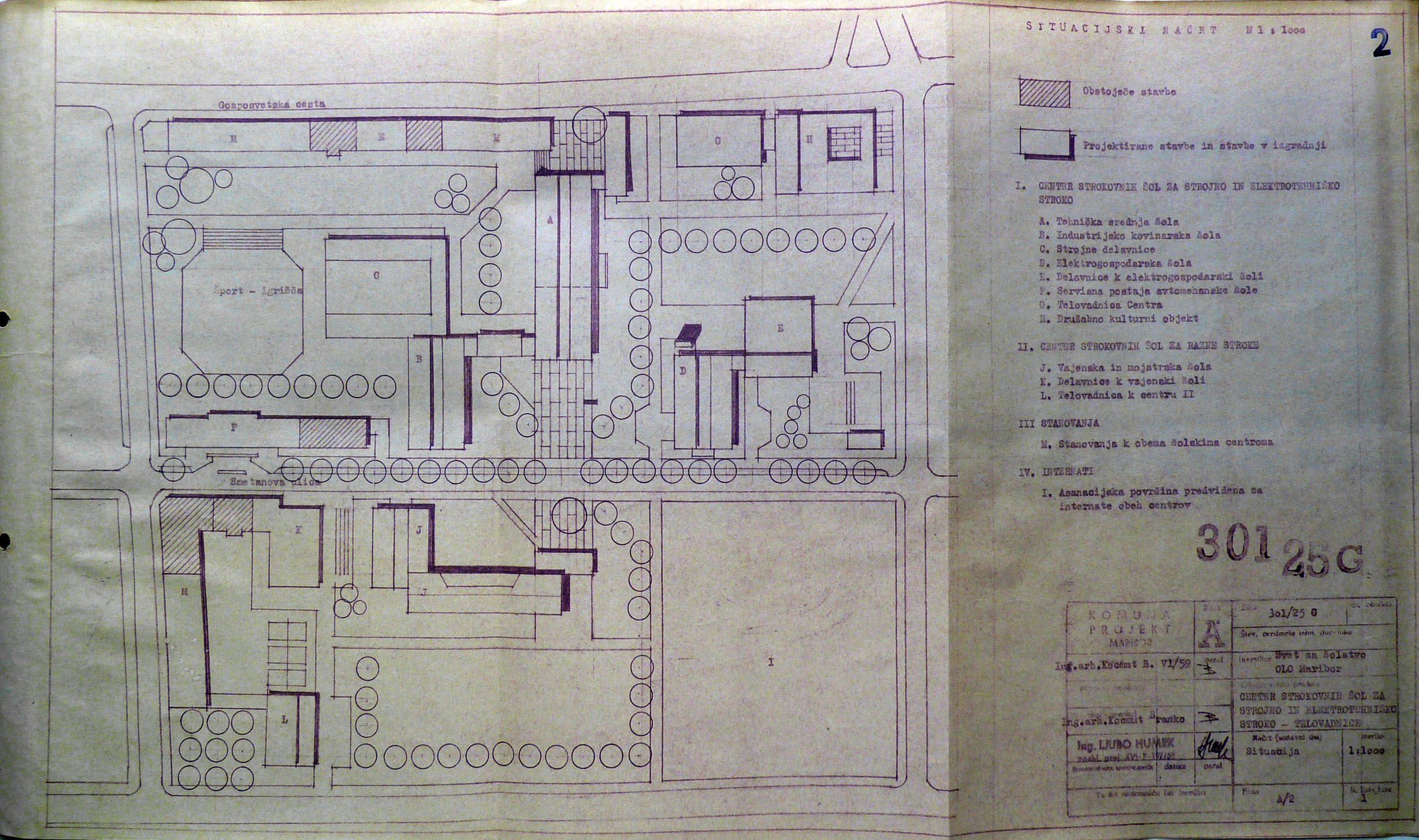
The site plan from 1959 planned the construction and park regulation of the area between Smetanova ulica, Prežihova ulica, Gosposvetska ulica and Strossmayerjeva ulica, while a part of the buildings was supposed to reach even to the southern side of Smetanova ulica and include the Historicist building on the corner between Smetanova and Prežihova ulica as well. Not all of the buildings from the outline plan were realized; a repair shop station with an automobile repair shop, a gym with a pool (Kocmut planned both on the northern side of Smetanova ulica), a boarding house, a social-cultural building (planned along Gosposvetska ulica), and apartments for personnel (along Gosposvetska ulica and on the southern side of Smetanova ulica) were not built. A large surface on the western side along Prežihova ulica, which was intended for playgrounds and outdoor rallies, remained unrealized as well. The discussion about the construction of the gym with a pool dragged on the longest 13 the documentation dates back to 1961.
As early as 1956, the District People's Committee of Maribor issued an order with which it determined the land for the construction and began the procedure for the unification of the building plots. The District People's Committee of Maribor, Council of Education, was also the construction investor, and in 1957, the investment program was confirmed by the Executive Council of the People's Assembly of the People's Republic of Slovenia. The terrain rises slightly from the south to the north; at the same time, it has a diverse configuration, which the architect preserved. The latter is one of the characteristics of his planning. The entire complex is built in reinforced concrete framework, while massive concrete ceilings were also used. The stairs are made of prefabricated concrete, the partition walls and outer walls from hollowed bricks. On the site plan from 1959, the buildings are marked with letters from A to M, however, only the buildings marked from A to E by Kocmut in the project documentation were realized.
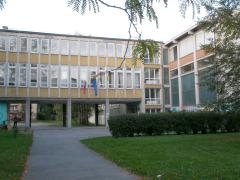
Building A was primarily intended for a secondary technical school with a mechanical engineering and electro-technical division and a precision engineering shop. Today, it houses the School of Electrical Engineering and Computer Science, while a part of the building is leased to the Faculty of Engineering. The projects were made in 1957, the construction was concluded in 1958. The elongated building is situated in the middle of the area and is diverted from the north to the south with a slight deviation. In the northern part, a short and transparent hallway running from east to west connects it to the narrow and elongated building, which stretches to Gosposvetska cesta and is oriented north-south as well.
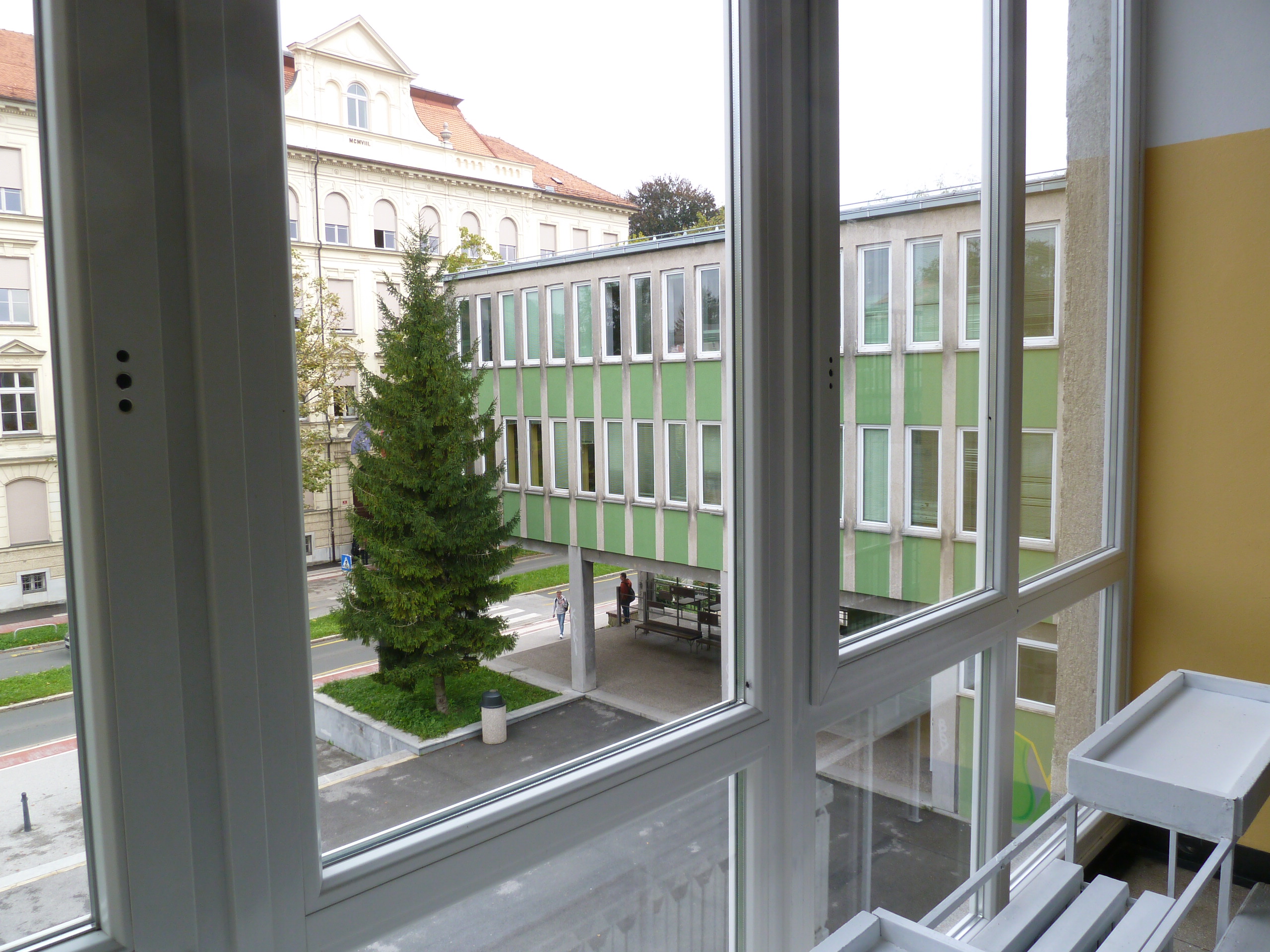
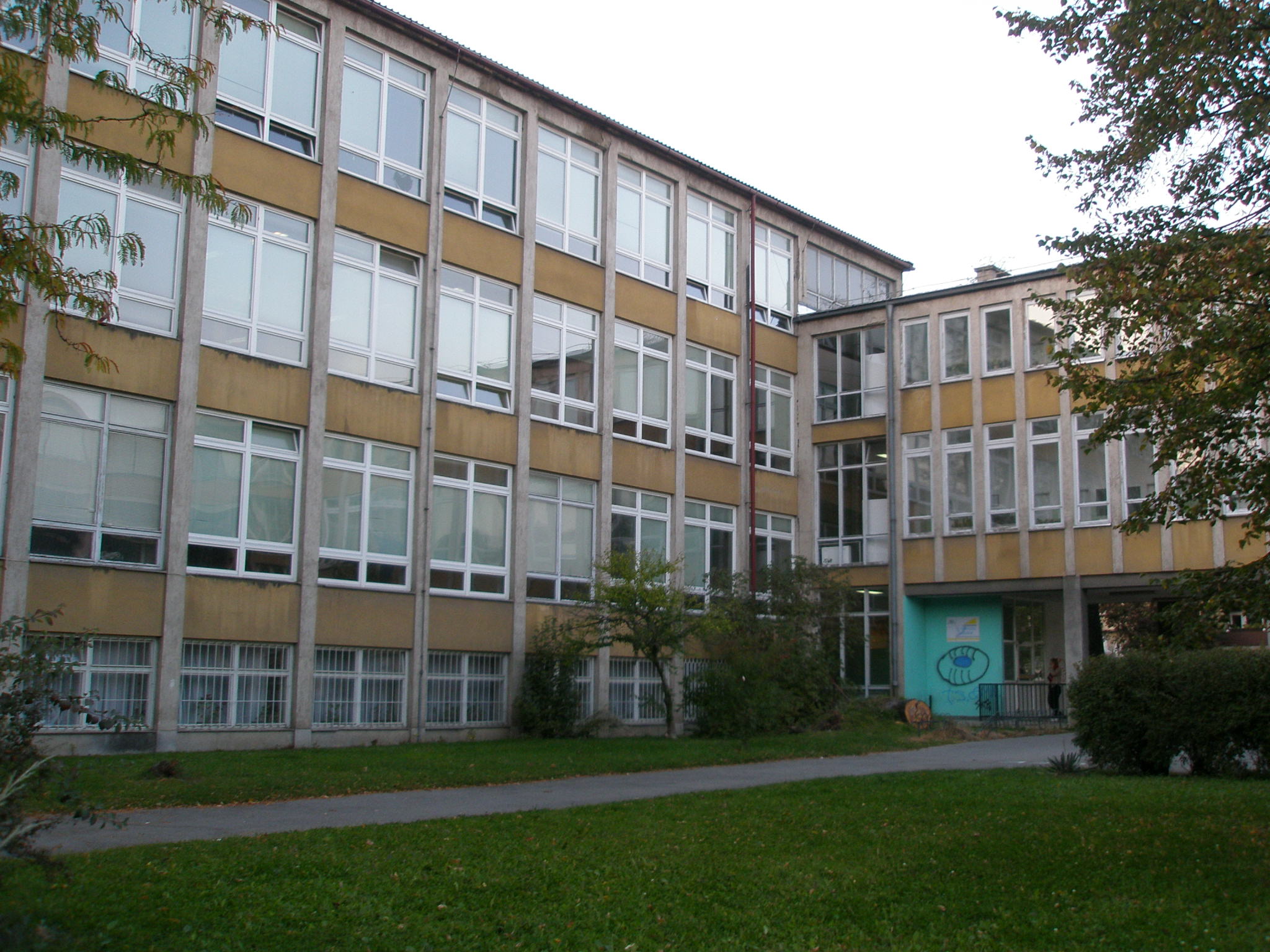
The central part of building A is divided into two parts by a short transparent hallway. The façades of the northern, two-storey part are marked with an articulation of a thick string of windows with outer shades, while the wall underneath is green. The design of the façades of the southern part is similar to building D; the walls are more compact, while a shallow oriel in the width of six window bays is visible on the second and third floors of the eastern façade. Building A has a flat roof, while in the southern part, the roofing is the same as on building D: a deepened shaft runs in the middle; its glazed walls illuminate the mansard floor. Both halves of the roofing rise towards the shaft in a slight arch. The ground floor of the western façade, where the shops are, is made of thick non-transparent glass plates.
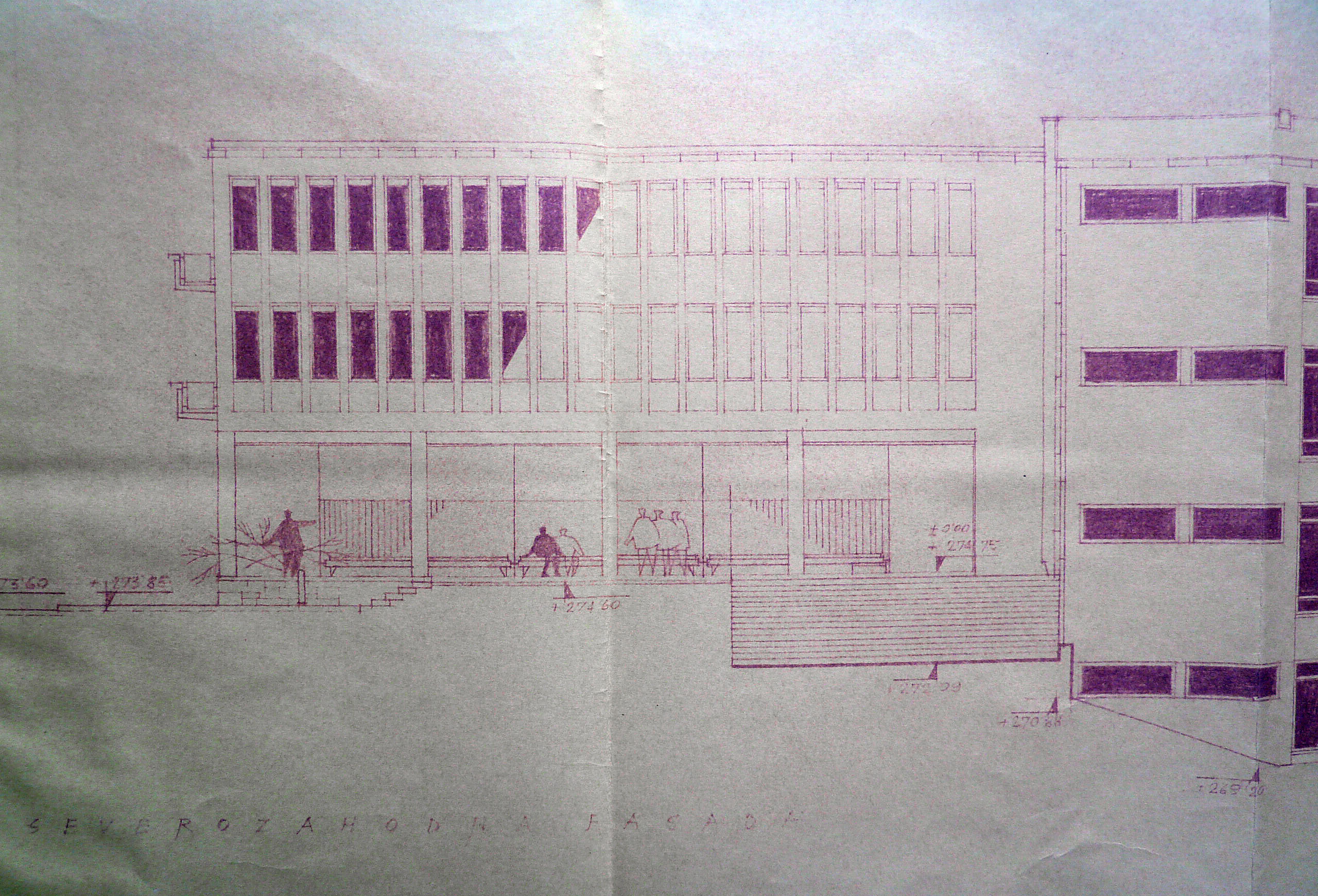
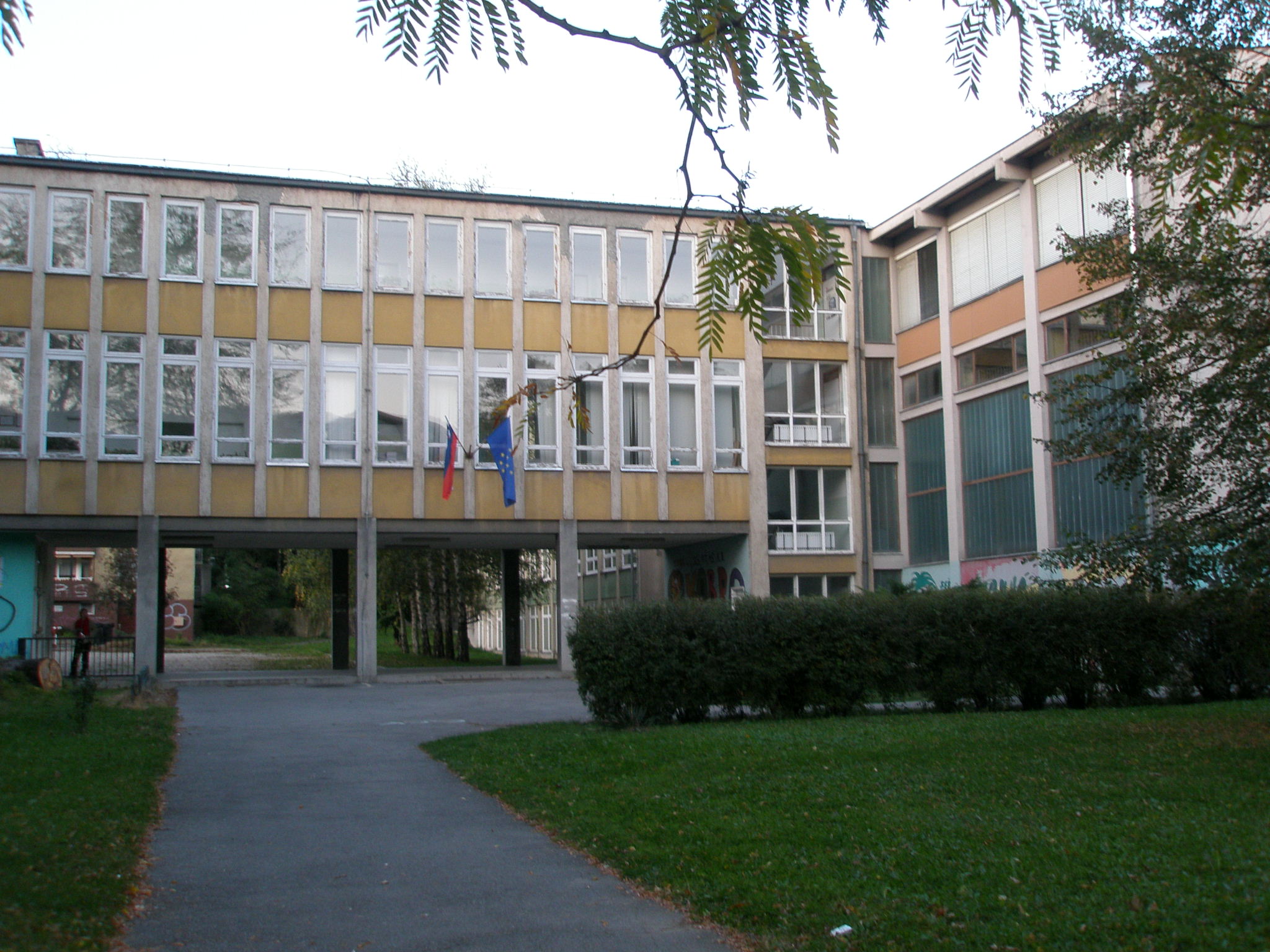
The most interestingly designed part is the narrow elongated wing in the northern section, which is supported by columns and through which we enter the school building from Gosposvetska ulica. It was intended to be used by school administration and it still is. When accessing the building from the street, one must climb a few stairs since there is quite a big difference in the level of the street and the terrace that provides access to the building. The square terrace is paved; its southern edge is delineated by the northern façade of the A wing and a transparent connecting wing, through which we can see the other side of the building. A green with a concrete sculpture by Momčilo Krković (1929-2011) from 1970, one of the sculptures made during Forma viva Maribor, lies on the western edge of the platform. The sculpture is hidden by bushes that are too ramified. On the western edge, stairs lead from the platform to buildings B and C.
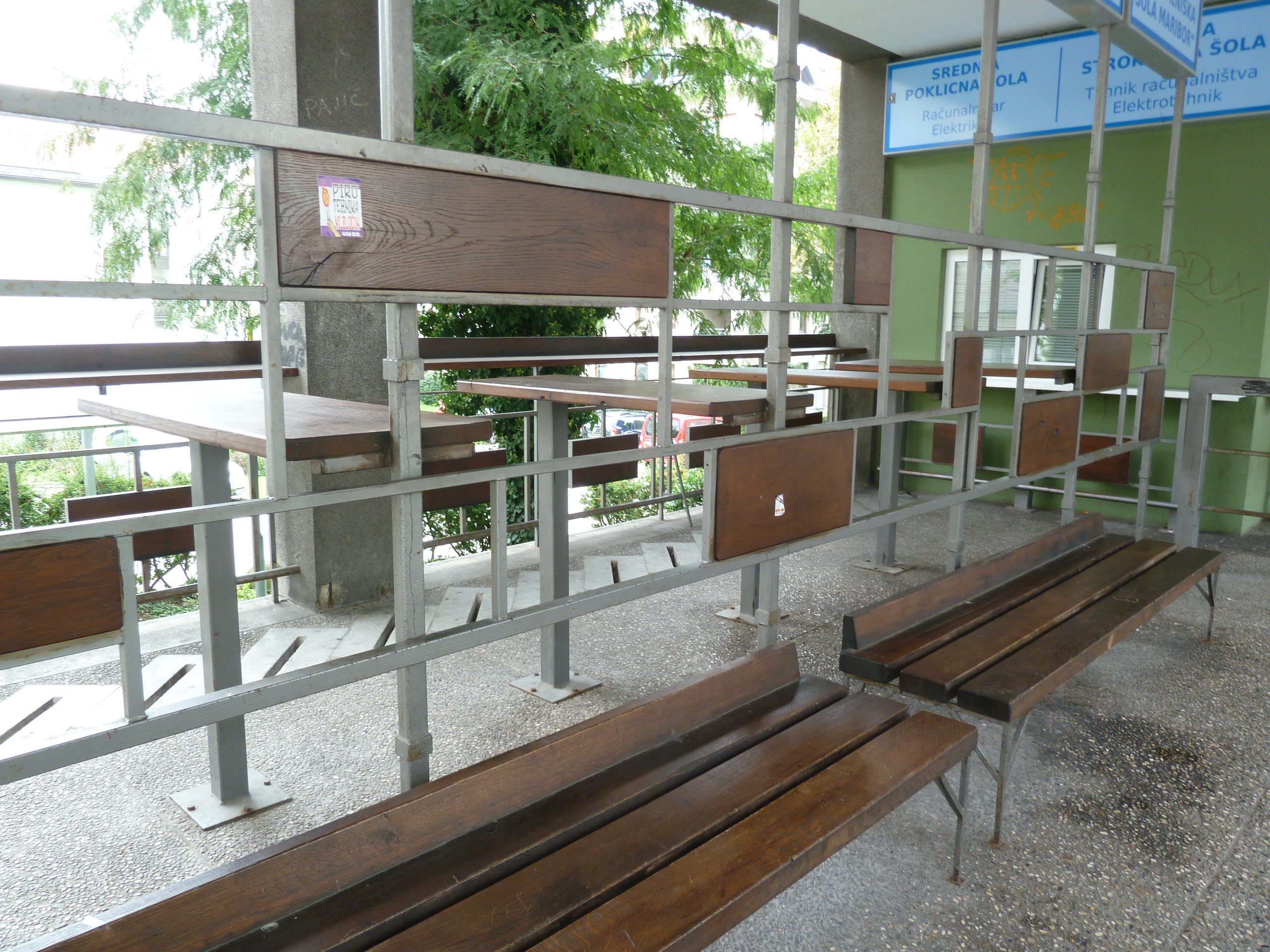
Slim columns on the ground floor of the entrance wing are covered with terrazzo. A terrazzo pavement and an interesting articulation of the colonnaded lobby with a metal fence, in which some openings are filled with wooden boards, are also preserved. On the eastern side of this narrow partitioned hallway there are also original wooden depositional tables and pavement openings for bicycles. All façades of this wing are articulated with strings of narrow high windows, while on the floor of the northern façade above Gosposvetska ulica there is a small balcony with a simple fence made of vertical metal rods and a concrete projecting roof. The latter is a typical motif of Kocmut, which the architect improved a few years later in the famous School of Economics and Commerce on Razlagova ulica. According to the plans, the same balcony was also planned on the second floor. The original wooden window frames on building A were replaced by plastic ones.
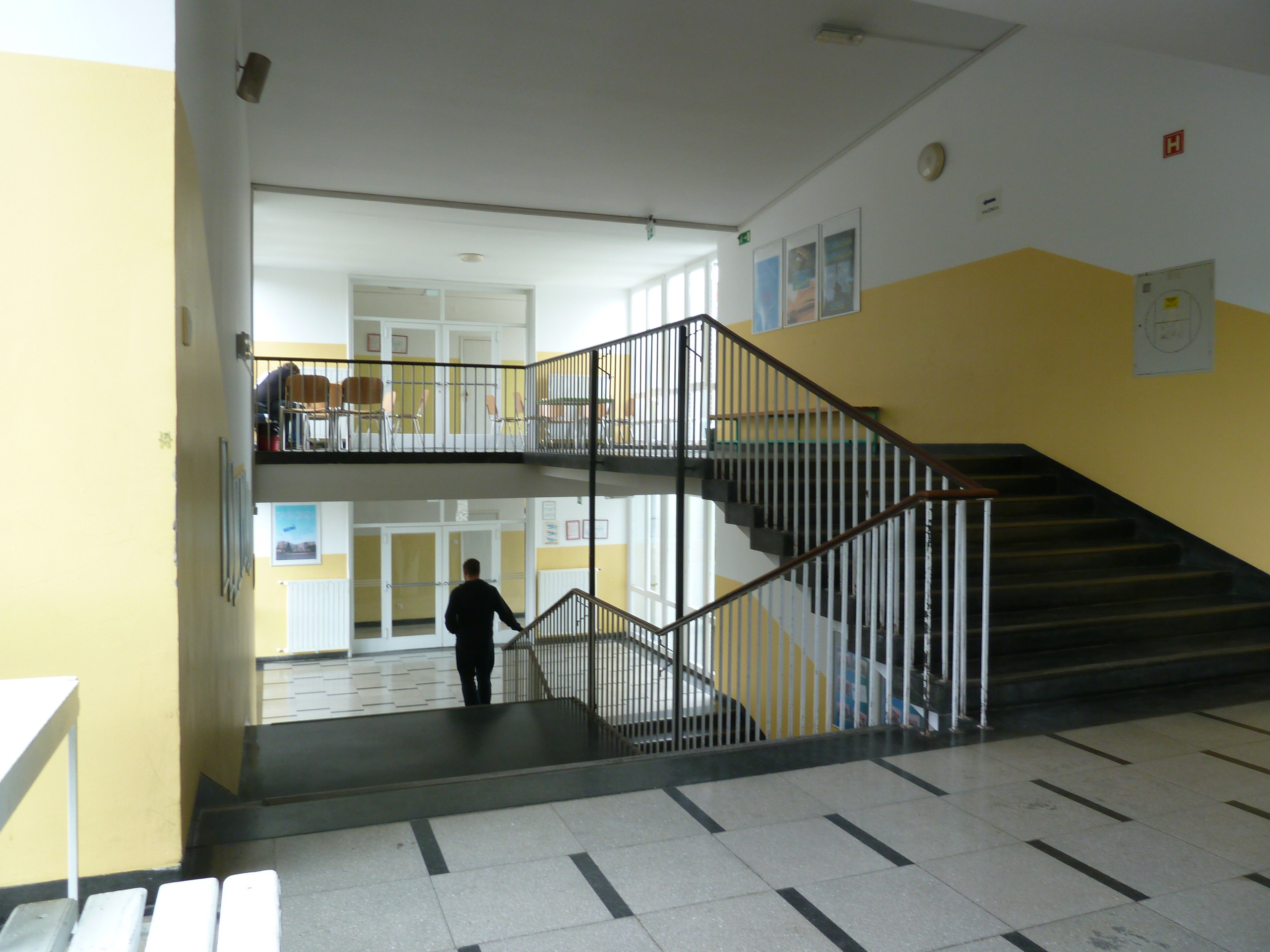
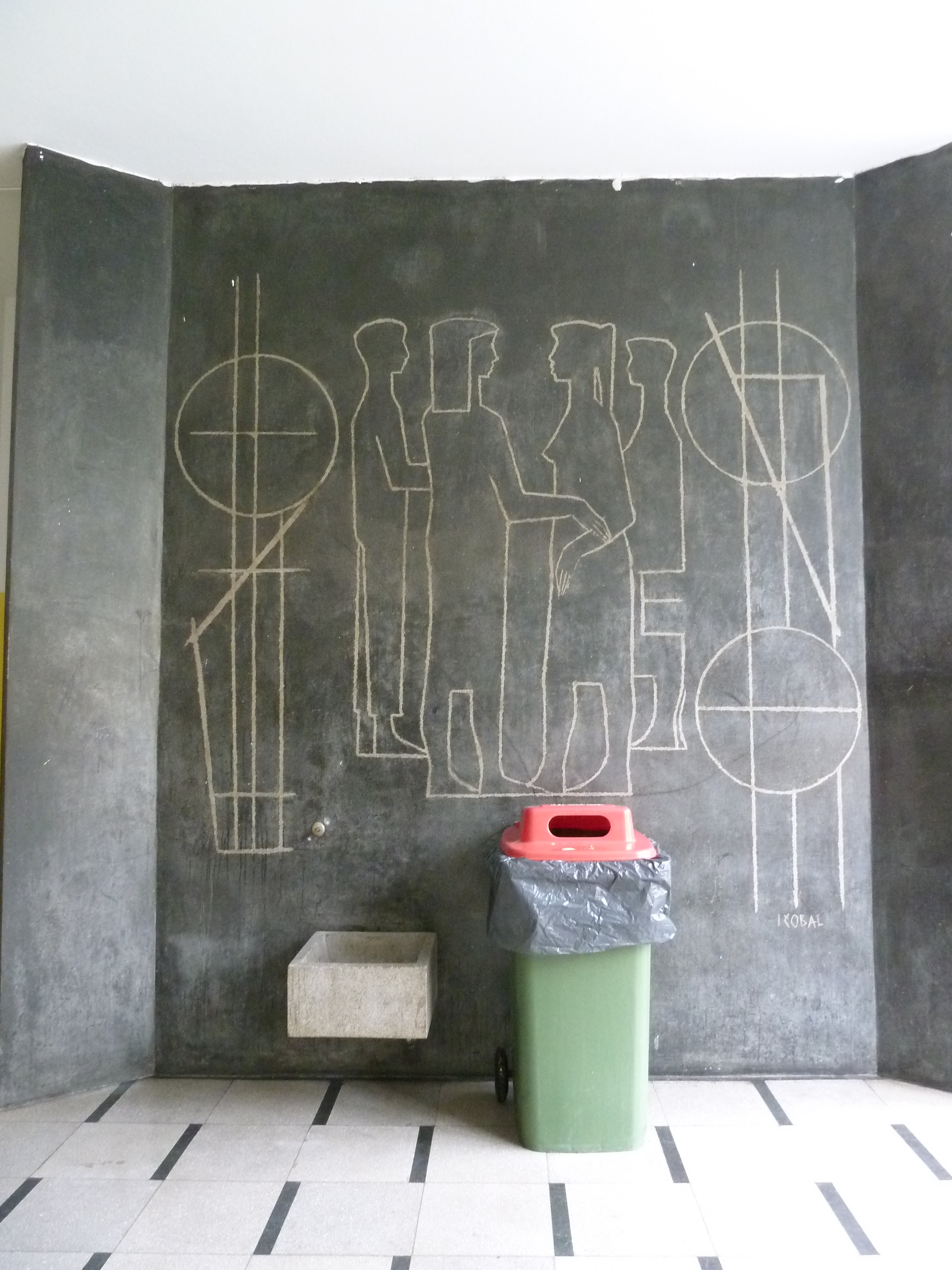
The entrance lobby is bright; its broad two-flight staircase, which receives plenty of light, leads to the first and second floors. The original floors are preserved 13 they consist of square light-grey terrazzo plates with dark lines, which create an interesting pattern. Two decorative walls on the opposite side of the staircase on the first and the second floor, which are made of terrazzo and block the view of the entrances to the bathrooms, are also interesting. Painter Ivan Čobal (1926-1995) drew into the dark terrazzo a light grey linear drawing in the same material. On the first floor he depicted the somewhat schematized figures of two girls and two boys, and on the second floor, two women caryatids frame the surface with a column in the middle and a silhouette of a lorry in the background. In the lower part of both decorative walls are two square pools 13 washbasins or drinking fountains, which are no longer functional. Unfortunately, the school does not have an appropriate attitude towards the interesting art decorations; on the first floor, a dustbin leans against the wall, while on the second floor, a water machine is attached to the wall in an incredibly thoughtless way. A hallway, which leads to the classrooms, divides all floors of the central part of building A in half.
Building B was primarily intended for a Master school of metalwork, an industrial apprentice school of metalwork and an apprentice school for the auto mechanic profession. Today, it houses III. gimnazija. The building is situated in the southwestern part of the area. It is comprised of an elongated two-storey wing, oriented north-south; its southern façade is situated on Smetanova ulica. In its northern part, a narrow wing on columns branches off towards the east; the wing is connected to building A through its southern extension. The central cube with a flat roof is similar in design to the central part of building A; its façades are divided by a dense string of windows, which are characterized by a thick raster of shades. The colour of the wall under the windows is ochre, which might be its original colour. The interior of the building is divided with a hallway, which leads to the classrooms. The narrow transverse wing is interesting with its colonnaded ground floor, which enables the flow of space between the buildings. The original terrazzo paving stones are still preserved on the floor, and even the openings for bicycles. The entire building is in bad condition.
Building C was primarily planned for engineering shops; today it houses III. gimnazija. It is situated along the northwest corner of building B with which it is connected. It represents a lower compact building with a square ground plan.
Building D was constructed in 1959 (plans from 1958) for the purposes of the School of Electronics and Business, while today it houses the School of Electrical Engineering and Computer Science. The building is situated in the southeastern part of the area and is joined with its southern façade with Smetanova ulica. The basic design of all of the buildings is repeated: from the elongated building, oriented north-south, a narrower wing branches off towards the east in a rectangle. The central two-storey building is intended for classrooms (on the ground floor there are also shops) accessible from the hallway, which runs through the centre of the building. The narrow wing is intended for administration. The southern façade is designed similarly to the one on the extension of building A: along the centre of the façade runs a vertical glazed band, which lights the hallways, while along the centre of the roof, which rises under a slight incline, runs a shaft with glazed sides, which illuminates the mansard rooms. Building D was recently renovated; the wooden window frames were replaced by plastic ones and the walls were coloured bright red.
Building E only has a ground floor that is used for workshops. It is connected to building D with a low, pass-through wing. It was built in 1959.
The construction of the secondary technical schools, which Jelka Pirkovič justifiably emphasises as a successfully planned school complex, can be evaluated as an important phase in the industrialization of Maribor. It reflects a time of economic growth in Maribor, as well as regulated municipal politics in the area of education, which also strove for high architectural and urbanist standards. Even though the buildings are still used for secondary school purposes, the attitude towards their maintenance (or lack thereof) and disrespect towards Kocmut's foundations is worrisome.
Marjeta Ciglenečki
(23 September 2014)